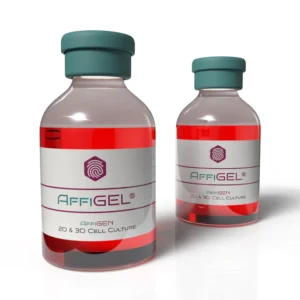
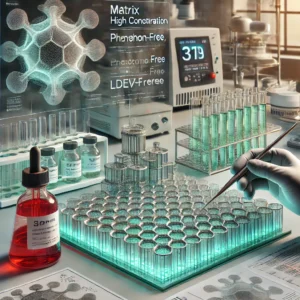
The Matrix High Concentration, Phenol Red-Free, LDEV-Free is specifically engineered for advanced cell culture applications that demand precision and reliability, particularly in fields where minimizing extraneous variables is critical. By eliminating phenol red and LDEV contamination, this matrix is designed to support high-fidelity experiments in stem cell research, cancer biology, and hormone-sensitive assays.
Enhanced Matrix Composition
The matrix provides an environment rich in extracellular matrix (ECM) components, which play a vital role in regulating cell behavior, adhesion, migration, and differentiation. The formulation closely mimics the in vivo conditions necessary for cell interaction and tissue formation. For further information on the role of ECMs in tissue engineering, refer to studies at NIH.
- Optimized Gelation Properties: The high concentration of ECM proteins, such as collagen and laminin, ensures robust gelation, creating a stable scaffold for 3D culture models. Gelation occurs rapidly under physiological conditions, making the matrix suitable for the formation of organoids and other 3D structures. The significance of ECM proteins is detailed on NCBI.
- Flexible Dilution Options: The high concentration of this matrix allows researchers to adjust its consistency according to specific experimental needs. Dilutions can be tailored to create softer or stiffer matrices, depending on the requirements of the cells being cultured. A flexible matrix is particularly useful in studies involving mechanotransduction, where cells respond to the stiffness of their environment. For insights into cell-matrix interactions, visit Science.gov.
Phenol Red-Free: Ideal for Hormone-Sensitive Studies
Phenol red is traditionally used as a pH indicator in cell culture media. However, it has been shown to have estrogen-like activity, which can interfere with experiments involving hormone-sensitive cells, such as breast cancer cell lines or primary endocrine cells. Eliminating phenol red from the matrix ensures that researchers can perform hormone assays and endocrine studies without the risk of estrogen mimicry affecting their results.
- Key Benefits in Endocrine Research: Hormone-sensitive pathways are involved in many critical areas of research, including breast cancer, reproductive biology, and endocrine disorders. With phenol red-free formulations, researchers can more accurately assess the effects of hormones like estrogen and progesterone without confounding variables. Visit NIDDK for more information on hormone research.
- Applications in Breast Cancer Studies: For breast cancer research, where the estrogen receptor plays a significant role, a phenol red-free environment is essential. It allows for the accurate testing of therapeutic agents like tamoxifen, a selective estrogen receptor modulator (SERM). More information on breast cancer assays can be found at Cancer.gov.
LDEV-Free: Ensuring Contamination-Free Cell Culture
Lactate Dehydrogenase-Elevating Virus (LDEV) can be a major contaminant in cell culture products derived from murine sources. It affects murine models, particularly immunocompromised mice, by altering the immune response and potentially skewing experimental results. This matrix is rigorously tested to be free of LDEV, ensuring the integrity of experiments that rely on murine cells or models.
- Importance in Immunology and Virology Research: The LDEV-free nature of the matrix is crucial for research involving immune cells, especially in experiments with genetically modified mice. Contaminated ECM products can cause immune dysregulation, leading to erroneous data. For protocols on avoiding viral contamination in cell cultures, refer to CDC guidelines.
- Use in Cancer Research Models: When culturing cancer cells in 3D environments or using xenograft models in mice, it is essential to eliminate viral contaminants like LDEV to maintain experimental fidelity. Learn more about the impact of viral contaminants in cancer research at NCI.

Applications in 3D Cell Cultures and Organoid Models
3D cell cultures and organoids have become essential tools in modern biological research, providing more physiologically relevant models compared to traditional 2D cell cultures. The Matrix High Concentration, Phenol Red-Free, LDEV-Free facilitates the formation of these complex structures by providing an optimal microenvironment.
- Stem Cell-Derived Organoids: Organoids are self-organizing 3D cell cultures derived from stem cells that mimic the architecture and function of real organs. These organoids are used for disease modeling, drug testing, and regenerative medicine research. The matrix’s high concentration and LDEV-free formulation are critical for maintaining organoid integrity over extended culture periods. For more on the generation of organoids, refer to Stem Cells.gov.
- Cancer Spheroids: In cancer research, 3D spheroids are used to study tumor microenvironments and test anti-cancer drugs. The matrix supports the growth of tumor spheroids, enabling more accurate drug screening and mechanistic studies. Additional resources on spheroid cultures in cancer research can be found at Cancer.gov.
Compatibility with Advanced Imaging Techniques
The matrix’s phenol red-free formulation also enhances compatibility with advanced imaging techniques, such as fluorescence microscopy and live-cell imaging. Phenol red can cause background fluorescence and interfere with the visualization of fluorescent probes, but its absence allows for clearer and more accurate imaging.
- Fluorescence Microscopy: Researchers can now image cells in the matrix with minimal background interference. This is particularly important for studies involving live-cell imaging or fluorescent reporters. For imaging protocols, see Nikon Microscopy U.
- Confocal Microscopy: In 3D cultures, confocal microscopy is often used to obtain high-resolution images of cells within the matrix. Without phenol red, researchers can achieve clearer sectioning and more accurate image reconstruction. Learn more about confocal microscopy techniques at NIH’s Confocal Imaging Core.
Protocols and Best Practices for Use
- Matrix Preparation: Depending on the application, the matrix can be used at full concentration for stiffer 3D cultures or diluted for softer, more flexible cultures. The matrix should be thawed on ice before use and mixed gently to avoid introducing bubbles, which can affect gelation.
- Refer to CDC guidelines for handling biological materials.
- Cell Seeding: After preparing the matrix, cells can be seeded directly into it for 3D culture. The matrix should be allowed to solidify in a cell culture incubator at 37°C, after which culture medium is added.
- Detailed cell culture protocols are available at Grants.gov.
- Imaging and Analysis: For imaging studies, cells cultured in the matrix can be stained using live-cell dyes or fixed for immunohistochemistry. The matrix is compatible with most standard fixation and staining protocols.
- Additional microscopy techniques are detailed at NIH’s Microscopy Resources.
Conclusion
The Matrix High Concentration, Phenol Red-Free, LDEV-Free represents a significant advancement in cell culture technology, providing researchers with a reliable and versatile tool for growing cells in physiologically relevant environments. Its high concentration, combined with the absence of phenol red and LDEV, ensures minimal interference with sensitive biological assays, especially in hormone-sensitive studies, cancer research, and stem cell applications. Researchers can benefit from its compatibility with advanced imaging techniques and 3D culture models, leading to more accurate and reproducible results.